The Good, Bad & Ugly 2010: Canadian soccer

In a country dominated by hockey, soccer doesn’t often get the love and respect that it deserves. With over 1.3-million male and female registered players – and millions more fans – soccer in Canada gets surprisingly little attention on and off the field. The sport is largely ignored by international players as well as the media.
2010 saw riveting international soccer stories from the World Cup and league competitions around the world. But the year also saw its share of bad – and downright ugly – events on the pitch.
Will the hiring of German soccer icon Juergen Klinsmann be enough repair Toronto FC after an ugly 2010 season?
(Nathan Denette/The Canadian Press)
The Good
There is no story in Canadian soccer this year that can compare to the success of the national women’s team.
In 2010 the team became a world power, led by the talented B.C. native Christine Sinclaire (six time winner of Player of the Year). The ‘Big Red’ decimated all of their opponents at the CONCACAF Women’s Gold Cup, qualifying them to the 2011 FIFA Women’s World Cup in Germany. The women won every match at the tournament without allowing one goal into the net.
And as recently as December 19, the Canadian women tied their 10-match, unbeaten record following a 2-2 draw against soccer power house, Brazil.
There’s no doubt that the women’s national team will continue their strong performance into 2011, which could prove to be another record-breaking year.
The Bad
While the women’s team made headlines, then men’s team wasn’t anywhere to be found. As Canadians watched the World Cup in South Africa, many (if not all) of them wondered why our home and native land was missing from the world’s largest sporting event. However, Canada hasn’t qualified since 1986 – and don’t look likely to make it any time soon.
In 2010 the team played six friendly games, winning only once. Who could forget the 5-0 drubbing by Argentina weeks before the World Cup began?
The men’s team currently sits 84th in the FIFA world rankings which puts Canada 21 places behind New Zealand, 58 behind Australia and 66 places behind our neighbours to the south, the United States. Pretty bad.
Canadian fans would love nothing more than to cheer on a winning (or at least respectable) team. Is our country so devoid of talent that we can’t put together a decent men’s squad? Or are there deeper issues with the infrastructure of Canadian soccer?
Whatever the reason, Canadian fans will continue to cheer on their favourite foreign teams while our domestic players remain in obscurity. And Canadian soccer will suffer for it.
The Ugly
There wasn’t much pretty about Toronto FC in 2010. From Mo Johnston’s ineffective - and overstayed - leadership to head coach Preki’s lack of ability to win over the locker room (which led to his inevitable firing), the past year didn’t offer much hope to the fans. Five coaches in five years and never seeing the playoffs – it’s not something to be proud about.
After starting the year well by going undefeated for seven games, the second half of the season saw the team fall apart. Who will forget TFC’s worst game against DC United, MLS’s last-place team? A win would have kept Toronto’s playoff hopes alive. But TFC’s uninspired play gave United a 1-0 win, effectively ending the Reds’ season.
And the “support” from Maple Leafs Sports and Entertainment left little to be desired. The prospect of rising ticket prices (to watch yet another losing Toronto team) left fans bitter and led to protests and town hall meetings between supporters and MLSE. The ownership responded by firing Johnston and apologizing the team’s lack of success on the pitch.
The next year does look to be more positive, however; there is new staff in the head office and an obvious commitment to the team’s performance by MLSE. They’ve hired German soccer icon Juergen Klinsmann to consult on how to improve Toronto FC. And with the Vancouver Whitecaps entering the MLS this year and Montreal Impact in 2012, fans might just have a reason to be excited for the future.

Exclusive – Bernstein vows to rebuild bridges with FIFA

LONDON, ENGLAND - NOVEMBER 25:  Chairman of We...Image by Getty Images via @daylife


David Bernstein has vowed to rebuild bridges with FIFA once he takes up his role as the chairman of the Football Association.
Bernstein will officially take over in February if, as expected, his appointment is ratified by the FA Council on January 25th.
And Bernstein admits one of his main tasks will be to mend relations with football’s world governing body after the bitter fallout from England’s failed 2018 World Cup bid.
“There’s a lot to be done,” the former Manchester City chairman told talkSPORT. “I think the first thing to be done is to rebuild bridges.
“These relationships are very, very important. There’s no point going in a corner and sulking - we have to move on. So, although it won’t be the very first thing on my agenda, certainly talking to FIFA and UEFA and so on and moving things forward with them is very important.”
Bernstein beat off competition from the likes of former Arsenal vice-chairman David Dein to land the job, and the 67-year-old admits he has a tough task to turn the FA’s image around.
There’s no point going in a corner and sulking - we have to move onDavid Bernstein
“The FA is a fantastic body and there is a huge amount of work done by the FA across all manner of fields which is really very, very commendable,” added Bernstein.
“However, there’s been issues at the very visible end of the FA with the World Cup and the World Cup bid and a lot of changes of chairman and chief executive and so on which has caused perception problems.
“I think it's a number of these big issues that i will need to be involved in to try and ensure that the great work done by large parts of the FA is properly recognised.
"One of the advantages of having this period between now and February is that I intend to speak to a lot of people both inside football and connected with football.
"There’s a lot of important issues clearly facing English football and I’m going to have to be involved in a wide range of things."

Kenya calls for correct Fifa path

By John Nene
BBC Sport, Nairobi

KFF secretary-general Omondi Aduda
KFF official Omondi Aduda says it should be his duty, not Fifa's, to call for elections
The Kenya Football Federation (KFF) has advised Fifa to tread carefully as the world body prepares to announce an independent committee to supervise national elections next year.
Omondi Aduda has stated that any independent committee must first be registered at the Registrar General before it can call for elections in the divided footballing nation.
At present, the current association recognised by Fifa as running the game - Football Kenya Limited (FKL) - is unable to call for elections because it is a company.
"Legally I'm supposed to call for the elections, because we're registered as an association, and issue a 21-day notice as the laws of the land state," KFF secretary-general Omondi Aduda told BBC Sport.
"But since Fifa does not recognise us I can't do that.
Mistakes have been made and rules broken - now it's time for all of us to work together
Kenya Sports Minister Paul Otuoma
"Now that that they've said we must keep off the polls, they should ensure that the committee they intend to form must be registered first - because even Fifa cannot call for polls.
"Fifa needs to come out in the open and tell us under which association these elections will be held and who will issue notice for the elections."
Kenya's sports minister Paul Otuoma has sidestepped the issue by saying that Fifa will decide how elections will be conducted and who will head the committee supervising them.
But the minister told Fifa that the government will not accept an unsatisfactory election procedure, saying that Fifa has contributed to the problems facing Kenya football by recognising a company (FKL) to manage football.
"Mistakes have been made and rules broken, but now it's time for all of us to work together and put an end to leadership wrangles once and for all to revamp our football," said Otuoma.
FKL chairman Mohammed Hatmy said he supports Fifa's decision to appoint an independent supervisory committee.
"We have no problem with the committee, we will fully cooperate with them," said Hatmy.
Some analysts view Fifa's move as an indication of their desire to part ways with the FKL after erring in allowing a company to run football in the East African nation.
"I want to state that I will defend my seat in the elections," Hatmy added.
FKL is already a divided house with senior vice-chairman Titus Kasuve accusing a top FKL official of frustrating former coach Jacob 'Ghost' Mulee, who resigned in a huff last month after the national team's disastrous performance in the Cecafa Challenge Cup.
The Harambee Stars exited the Tanzania-based finals in the first round without notching a single win.

World Cup Cash To Fund 3-Star Hotel

 
Related Stories
 
The financial reward of Ghana’s participation in the 2010 FIFA World Cup will be channeled towards the construction of a three-star hotel at the Ghanaman Soccer Centre of Excellence at Prampram in the Dangbe West District of Greater Accra Region.

The hotel with an Olympic-size swimming pool amongst other facilities will serve as a major camping base for the various national teams and also operate as an income generating venture. Ghana reaped 11 million US Dollars after taxes for reaching the last eight of the first ever Mundial on African soil, South Africa and Ms Akua Sena Dansua, Minister of Youth and Sports said at an interaction with the media on Tuesday that the hotel facility was amongst the consideration of a legacy project for the country.

Ms Dansua said there were many proposals with the Ghana Football Association (GFA) in respect to the legacy project and the three-Star hotel project received an almost positive response. “The parties have not finalized discussions, and the project can only take off after all parties have consented to it.

But for the recent problems between the GFA and the Economic and Organised Crime Office (EOCO), discussions would have been advanced according to the Minister. Ms Dansua confirmed that the cash was still in Government coffers and will be channeled through for the approved project at the right time.

The project, she said, will be synonymous with Ghana’s heroics at the Mundial which saw the Black Stars become the first African team after Cameroon and Senegal to reach the quarters of the World Cup.

FIFA Has Made Historic Decisions In Terms Of Sport And Geopolitics - Sepp Blatter

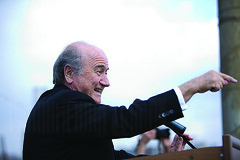
Head of FIFA Joseph "Sepp" BlatterImage by PanARMENIAN_Photo via Flickr
FIFA president Sepp Blatter has defended the decision to award Russia and Qatar the 2018 and 2022 World Cups by claiming that it's only natural to keep on moving into new regions.

"We have made historic decisions in terms of sport and geopolitics. We’ve sent the World Cup to new territories. The 2018 World Cup will go to eastern Europe and the vast country that is Russia, and the 2022 event will go to Qatar, in the Arab world. The World Cup will discover new cultures in new regions, and that’s something I’m delighted about," said Blatter to fifa.com.

"You need to follow the development of football and FIFA to understand these decisions. It’s not something that started yesterday either. My predecessor Joao Havelange said that football had to become a universal sport. There was a need to promote football and look for sponsors because we didn’t have a cent back then.

"When I jumped into this project in November 1974 I did so with my feet tied together, and I could see straightaway that there was more to football than just kicking a ball. When I became the FIFA President, the decision was made to go into Asia. And then I said we had to go to Africa, which is what we did. It’s only natural, then, that we should keep on moving into new regions."

PM's unwise rush to worship at the altar of Oprah

Julia Gillard on stage with Oprah.

It is advisable to set your price limit before bidding at an auction. Some people get carried away by emotion and pay way over the odds. Which is what the vendor wants.
Australia spent $45 million on its bid to host the FIFA World Cup, which apparently got us one vote. To win we needed 12. We are pretty lucky our government didn't go all out because this could have got as expensive as its program to install insulation batts.
I was in the Gulf when the decision was announced. People offered commiserations over Australia's defeat. But, of course, they were glad Qatar won. Qatar is precisely the kind of place to host a World Cup. It has plenty of money to build the stadiums, roads, and hotels. There won't be any labour disputes or delays of the kind that plagued the Commonwealth Games in Delhi. It will be done to an extravagant budget and finished on time.
Qatar is a major oil producer. Its gas reserves dwarf those of Australia. The labour to do the construction will be mostly imported. Out of a population of about 2 million, only a minority are actually Qataris, and - along with Lichtenstein - they have the highest per capita income in the world. There is no tax in Qatar. The funds to host the event will come from the country's oil and gas revenues, which are ultimately owned by the ruler, Sheikh Hamad bin Khalifa Al-Thani.
When Abu Dhabi decided to stage its formula one race, it developed a whole island - Yas Island - with hotels, marinas and permanent grandstands, at a cost estimated at $40 billion. Does that mean that Australia should pay a similar sum to stage its race? Not for a moment. If the oil-rich kingdom has that kind of money to spend, that is a matter for it. Many Australians will have the chance to go there and enjoy it. But we don't have a spare $40 billion sitting around - not even for uncommercial projects such as the national broadband network.
There are benefits in promoting tourism to Australia, and major events such as the Olympics or the Commonwealth Games can draw in tourists. But I have never believed the claims that they run at a profit. Our best tourism campaign was Paul Hogan throwing another shrimp on the barbie. It cost so little that Hogan's fee hardly troubled the Tax Office.
The recent visit of Oprah was a piece of sensational public relations. Time will tell whether it boosts visitor numbers. But for a week it put Australia right in the forefront of exposure to the world's largest economy. The coverage was as sympathetic as you could imagine. It had a lot of stereotypes - crocodiles, snakes and the like - but that's what tourists look for.
It helps to have our own famous people - Hugh Jackman and Russell Crowe - promoting Australia in these programs and good on them for doing it. But one of our famous people who climbed on the bandwagon should not have been anywhere near the scene of the Opradulation.
Julia Gillard is the Prime Minister of Australia. She is the person ultimately responsible for sending troops into battle. She is the one who must stand up and insist our country is treated with respect in international forums. She is not a support act for a visiting US celebrity. She didn't do well. In fact, it was cringe-making.
When previous Australian prime ministers such as Harold Holt and John Gorton got star struck by the Americans, at least it was for presidents - they didn't gush in the presence of TV personalities.
The Roman poet Juvenal lamented that the politicians of ancient Rome had cheapened the empire with a policy of "bread and circuses".
The Prime Minister needs to look, well, prime ministerial. The present government is faltering. Sound government rather than media spin would give it some respect. Big sporting events are nice - the kind of thing you might do when the basics are covered. But events management is best run by those that have unlimited resources to stage them.
Citizen democracies must be careful to use taxpayers' money sparingly and wisely. And the Prime Minister should never, never think she can become a celebrity. If she were any good at that she would not be in politics.

FIFA awarded tax-free in Brazil to organize 2014 World Cup

2014 FIFA World CupImage via Wikipedia
BRASILIA, Dec. 21 (Xinhua) -- Brazilian government published on Tuesday in the official Gazette a law that establishes a series of exemptions from federal taxes for the FIFA to organize the 2014 World Cup and the Confederations Cup in 2013.
The exemption enters into force on Jan. 1, 2011, and is one FIFA's requirements to hold the World Cup in the country.
According to the law, for the preparation of the event, FIFA does not need to collect taxes on imported goods (IPI), the contribution to Social Security Financing (Cofins) on imported goods and services, and the Contribution to the Programs for Social Integration and Heritage Formation of the Public Servant ( PIS-Pasep) on imports.
However, the exemption for equipment and construction of the stadia to be used for training the teams in the World Cup's 12 host cities was not authorized by Brazil's Ministry of Finance.
The ministry said the exemption would allow "undue expansion of tax incentives to stadia with the purpose to offer support, whose characteristics deviate from the aims and the reasons justifying the granting of benefits."
According to Brazil's Ministry of Sports, the country gains with the Cup will be greater than the tax exemption granted to FIFA.
The Ministry states that the collection of taxes due to the economic movement generated by the event will amount to about 9.5 billion dollars, while the exemption is estimated at about 600 million dollars.

2010: The year Africa held its first World Cup

JOHANNESBURG, SOUTH AFRICA - JANUARY 21:  In t...Image by Getty Images via @daylife
LONDON — The World Cup finally made it to Africa in 2010 and plans were made to send football's showpiece to even more new destinations.
After South Africa overcame dire predictions of security problems and half-empty stadiums to stage a World Cup that united the country in celebration, FIFA voted to give future tournaments to Russia and Qatar.
South Africa's first-round exit made it the least successful host team in World Cup history, but the rest of the country mostly coped admirably with its biggest global gathering since the end of a decades-long boycott by world sport.
Fans worldwide became intimately acquainted with the incessant buzz of the vuvuzela as South Africans celebrated the World Cup and the arrival of many of the superstars they had only ever seen before on television.
But on the field, the World Cup was far from a classic. Spain's 1-0 win over the Netherlands came in the dirtiest ever final, which was an appropriate end to a tournament that promised much but delivered little.
While Germany again thrilled neutrals to take third place for a second straight tournament, Brazil was dour. Italy and England were even worse, but France took the unofficial title of tournament laughing stock — so consumed by dissent that players refused to train before a 2-1 loss to South Africa that confirmed the team's humiliating first-round exit.
Diego Maradona's presence as coach inspired his beloved Argentina to some fitfully entertaining displays, with Lionel Messi doing everything except score, but Germany dismantled the South Americans 4-0 in the quarterfinals and Maradona was fired soon after.
The fervor of home fans was quelled when five of Africa's six entrants fell in the first round. Although Ghana then beat the United States 2-1 in a game watched by 19.4 million Americans — a U.S. record beaten when 24.3 million watched the final — the remaining enthusiasm turned to anger when a deliberate handball by Uruguay forward Luis Suarez denied their adopted team a winner in the last minute of the quarterfinals.
Suarez was suspended from Uruguay's first semifinal match since 1954, but FIFA refused calls for additional punishment for a cynical act that became one of the most memorable moments of the tournament.
Even Spain disappointed despite following West Germany and France to become only the third side to hold the World Cup and European Championship trophies at the same time.
This was far from the stylish Spain that dominated Euro 2008 and cruised through World Cup qualifying with 10 wins from 10 games.
The Spaniards lost their opening match to Switzerland in the tournament's biggest shock, before 1-0 wins in each of the four knockout rounds made them the lowest scoring world champions ever, with eight goals from seven matches.
A squad dominated by homegrown Barcelona stars waited patiently for its talent to yield a goal before trusting that its technical superiority would allow it to keep the ball and deny the opposition the chance to equalize.
It worked, even against a brutal display from the Netherlands in the final at Soccer City in Johannesburg. With the teams facing a penalty shootout, Andres Iniesta scored with four minutes of extra time left to clinch his country's first World Cup.
The Dutch were handed nine of the final's record 14 yellow cards and defender John Heitinga became only the fifth man to get a red card on football's biggest stage.
It was a huge anticlimax, especially after a clearly frail Nelson Mandela had turned up to wave to fans at the stadium in Soweto where 20 years earlier he had held his first mass rally following his release from jail.
Spain coach Vicente del Bosque seemed to have tightened things up after Barcelona's shock defeat to Inter Milan in the semifinals of Europe's Champions League.
With Spain internationals Xavi Hernandez, Carles Puyol, Gerard Pique, Sergio Busquets, Pedro and Victor Valdes in its lineup, the defending champions dominated Inter with an astonishing 71 percent possession over two matches but left space on the counterattack to lose 3-2 on aggregate.
Inter's 3-1 win in the first leg owed much to the sort of precision and patience Spain would show at the World Cup, where Busquets and Xabi Alonso effectively mirrored Inter's defensive shield of Thiago Motta and Esteban Cambiasso.
Inter and Germany were just about the only sides able to stop Messi during a year in which he made sure the repeated comparisons between him and Maradona — still Argentina's greatest ever player — ceased to become far-fetched.
Messi helped Barcelona retain the Spanish league and scored an incredible 58 club goals in 2010 to maintain his status as the world's best player, despite Cristiano Ronaldo's sparkling form for Real Madrid.
The dethroning of Barcelona — which by mid December of the following season was unbeaten in 22 matches and had scored 31 goals while conceding only one in the last seven of those — was simply the latest entry in Jose Mourinho's astounding career.
Mourinho led Inter to an unprecedented treble of Serie A title, Italian Cup and Champions League, with Bayern Munich beaten 2-0 in the final in Madrid.
Mourinho swiftly quit Inter — still with a record of not having lost a home league match with any team since February 2002 — and went to Real Madrid. After a strong start to the 2010-11 season, Madrid was rocked by November's 5-0 mauling at Barcelona but, with his track record, Mourinho could still end the season on a high.
Inter won December's Club World Cup to end 2010 with an Italian record five trophies in a calendar year. Inter beat TP Mazembe in the final after the African champion had shocked Copa Libertadores holder Internacional in the previous round, but that was a rare high point under Mourinho's successor Rafa Benitez.
Benitez's former club Liverpool was embroiled in a lengthy and convoluted dispute over its ownership that was only resolved when Britain's High Court forced American businessmen Tom Hicks and George Gillett Jr. to sell up.
Liverpool remained in American hands as Boston Red Sox owners New England Sports Ventures bought the club, but the team was way behind England's elite on the field.
Officiating of the game continued to evolve as football's rule-making body agreed to reopen discussions on the use of goal-line technology after mistakes helped eliminate Mexico and England from the World Cup.
In Europe, UEFA expanded its experimental use of additional assistant referees into the Champions League.
But there could be more trouble ahead for FIFA after its decision to award the 2018 World Cup to Russia and '22 edition to Qatar.
World football's ruling body said it was trying to spread the game into new territory by giving the tournament to Europe's largest country and then the Middle East, but the move was overshadowed by allegations of corruption and a lack of transparency in FIFA.
Copyright 2010 The Associated Press. All rights reserved. This material may not be published, broadcast, rewritten or redistributed.

FIFA's farcical World Cup bidding process just gets more ridiculous

  • FIFA President Joseph Blatter oversaw the bidding process that awarded… (Fahad Shadeed / Reuters)

FIFA's farcical World Cup bidding process just gets more ridiculous

After awarding the 2022 tournament to Qatar, a bad idea in and of itself, it appears likely that soccer's world governing body will move the tournament to winter, which would only compound the lunacy.

Having made a mind-boggling shambles of the selection process for the 2018 and 2022 World Cup tournaments, Joseph Blatter and his cronies at FIFA are considering another monumentally stupid idea.
They want the 2022 event to be played during the European winter — specifically, in January or February — so that it avoids the appalling heat and humidity of Qatar in June and July, the months in which the tournament has been played for the last 80 yearsg

FIFA recognizes Araneta

Sports
IN a welcome development, the International Football Federation (FIFA) has recognized Mariano "Nonong" Araneta as the new president of the Philippine Football Federation, replacing Jose Mari Martinez who was booted out during the PFF Congress last Nov. 27.
The FIFA decision, contained in a two-page letter dated Dec. 20, 2010, was sent by facsimile to PFF General Secretary Ramon Manuel, a copy of which was sent to Malaya via email yesterday.
The letter, signed by FIFA Secretary General Jerome Valcke, noted the validity of the PFF Congress that ousted Martinez for "unauthorized disbursement of PFF funds, falsification of public documents and failure to return missing funds." Copies of the letter were also sent to Alex Soosay, general secretary of the Asian Football Confederation; Johnny Romualdez, PFF chairman emeritus; and Martinez.
The letter carried an opinion rendered by Geoff Thompson, chairman of the Association Committee and FIFA vice-president, who said that after going through the minutes of the PFF Congress last Nov. 27, he was of the opinion "the decision of the PFF Congress to remove and replace the PFF President (Martinez) was taken according to the PFF Statutes."
Araneta, in an interview yesterday, said the decision "is a vindication of what we have done.
"We have been supported by PFF members and we are very happy with the decision," he said, adding: "We have to move forward and continue with our program."
The FIFA decision, which also confirmed the designation of Ismael Batiles as the new PFF executive vice-president, means Martinez and his fellow officials will now be recognized in various international football events, including the AFC elections set Jan. 6 next year.
In his last act before his sacking was confirmed by the FIFA, Martinez waived the country’s rights to host the first semis game between the Philippines and Indonesia in the recent Asean Football Federation Suzuki Cup, saying the country has no pitch that meets international standards.
Despite appeals from the new PFF leadership, the AFF ruled that both semis games be held in Jakarta. Indonesia went on to win the first match last Thursday 1-0 and prevailed by the same score in the second match last Sunday to advance to the finals against Malaysia, which beat Vietnam in the other semis showdown.
Despite their defeat, the Filipinos, also known as "Askals," left Jakarta with heads held high, aware they have stamped their mark in Southeast Asia’s premiere football tournament.
Up next for the "Azkals" is the AFC Challenge Cup, a tourney for countries ranked way below FIFA standings.
The Challenge Cup is a home-and-away series, with the first round pitting the Philippines against Mongolia on Feb. 9 and March 15. If the Philippines beats Mongolia, it will advance to the next round against Myanmar, Palestine and Bangladesh. (Jimmy A. Cantor)

International players' union backs winter World Cup in 2022

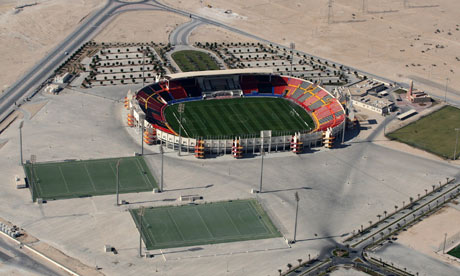
The Al-Rayyan stadium in Doha, Qatar
Temperatures could top 50C if the 2022 World Cup is staged in the summer. Photograph: Fadi al-Assaad/Reuters
The international players' union has backed calls to play the 2022 World Cup in Qatar in the winter instead of June and July – and claimed that players will be in better shape at that time of year. The Fifa president, Sepp Blatter, and the general secretary, Jérôme Valcke, have already thrown their weight behind moves to stage the tournament in January to avoid the heat problems.
Summer temperatures in Qatar can top 50C and the players' union Fifpro said it was pleased at Fifa's willingness to consider changing the timing to winter. Tijs Tummers, the secretary of Fifpro's technical committee, said: "We will have to take a careful look at the international match calendar, but Fifpro does not foresee any insurmountable problems in this regard.
"In Europe, competitive matches will have to be played in August and the second half of May and the first half of June. If you look at what happened last weekend with weather problems in Europe because of heavy snowfall, you could see this as an advantage rather than as a problem. And it might perhaps turn out that the players will be fitter at the start of a winter World Cup than was the case last summer in South Africa."
Tummers questioned the decision by Fifa to award Qatar the tournament based on playing in the summer. He added: "It is not sensible to award a World Cup in the summer to a country with an average temperature of 41C in June and July, a midday temperature of 50C and above all, extremely high humidity.
"Tourists are advised not to travel to Qatar in the summer months. Inhabitants of Qatar leave the country en masse during this period. The summer months in Qatar also do not provide suitable conditions for a festival of football such as the World Cup should be, including for the supporters.
"The organisers have guaranteed that the temperature inside the stadiums and at the training centres will be reduced to 27C by means of air-conditioning. That is all well and good, but it obviously does not fit in with ecological thinking, which we expect to be even more widespread by 2022."
Qatar bid chiefs have insisted that their air-conditioning of stadiums and training grounds would be "carbon neutral" as it would be based on solar energy.

Putin Says Russia Will Have High-Speed Rail by 2018 World Cup

If you haven’t heard Russia is hosting the 2018 FIFA World Cup, one of the biggest global events. It recently beat out England, Spain/Portugal, and Holland/Belgium for this fantastic opportunity. Of course, a ton of infrastructure development goes into preparations for the World Cup… the development of a high-speed rail network, for example.
Russia’s Prime Minister Vladimir Putin promised last week that there would be high-speed rail connecting all of the World Cup’s host cities (Moscow, Kazan, Samara, and Ulyanovsk) by 2018.
“It will be a powerful incentive for the development of high speed rail services in the European part of Russia,” Putin said.
Putin hasn’t provided a lot of detail yet, but he seems fully behind this plan.
The statement came immediately after he and Finnish President Tarja Halonen went on “an inaugural journey on the French-made high speed Allegro train linking Helsinki to St. Petersburg.” I think this is what more Americans need to really propel high-speed rail forward in their regions, real-world experience riding a high-speed train.
While, technically, the U.S. has had a high-speed rail line in the Northeast for 10 years now, trains on that line don’t really compare to what we consider high-speed rail today. Florida’s planned high-speed rail lines are likely to be the first truly high-speed lines in the U.S. The first line, from Tampa to Orlando, is supposed to be completed in 2014 and the second, from Orlando to Miami, in 2017. Will we really beat Russia to high-speed rail.

FIFA accepts Martinez's ouster as PFF prexy

MANILA, Philippines – The Fédération Internationale de Football Association (FIFA), also known as the International Federation of Association Football, has officially acknowledged the replacement of Jose Mari Martinez as president of the Philippine Football Federation (PFF).
In a letter faxed by FIFA secretary general Jerome Valcke to PFF general secretary Ramon Manuel, the FIFA said it has recognized the PFF's adoption to remove Martinez from office
“We consider that the motion to remove the PFF president Jose Mari Martinez was accepted and that he has been replaced by Mr. Mariano V. Araneta as the new PFF president,” said Valcke.
FIFA is the international governing body of association football, futsal and beach football.
Last November, the PFF Congress voted to remove and replace the Martinez "due to unauthorized disbursement of PFF funds, falsification of public documents, and failure to return missing funds before a set deadline."
Based on article 13.5 of the PFF By-Laws, "only the PFF Congress, by the affirmative vote of two thirds of the entire voting membership may remove and replace the PFF President upon the recommendation and majority vote of the Board of the Board of Governors."
The resolution to have Martinez removed was voted by 26 of the 33 total PFF congress members.
This prompted FIFA to acknowledge Martinez’s ouster.
The letter quoted the opinion of FIFA Chairman of the Association Committee and Vice President Geoff Thompson:
“Consequently, I am satisfied that article 13.5 prevails. I am therefore of the opinion that the decision of the PFF Congress to remove and replace the PFF President was taken according to the PFF Statutes.”
Elected to take Martinez’s place is Araneta of the Iloilo Football Association. Also chosen to become the PFF executive vice-president is Ismael Batiles.
FIFA said Araneta and Batiles will hold office for the unexpired period of the mandate of the PFF Board of Governors until November 26, 2011, as decided by the PFF Congress.

Fifa not a circus, says Blatter, as he hands over R560mFifa not a circus, says Blatter, as he hands over R560m

Fans celebrating the upcoming 2010 FIFA World ...Image via Wikipedia
 The World Cup was "not a circus", Fifa president Sepp Blatter said at the launch of the 2010 Fifa World Cup Legacy Trust for South Africa on Monday.

Fifa did not come into a country, "putting up some tents, and then, when everything is over, taking everything away," he said at the launch at Johannesburg's Soccer City.

Comedy scriptwriters dream of this sort of stuff, especially when Blatter followed it with: "Money is not so important for us, to say how much we put here or there."

This attempt at modesty by the president of the football world governing body that made an ­estimated $3,2-billion solely from sponsorship deals and television rights for the World Cup in South Africa came as Fifa announced that the trust will have a start-up budget of $80-million (R560-million).

The R560-million comes from profits on ticket sales during the World Cup, which amounted in total sales to R5,1-billion, according to a PricewaterhouseCoopers study of global sports, entitled Back on Track?, which was released in August.

The trust will cater for football development, education and humanitarian projects in South Africa.

South Africa's outlay for the tournament, inclusive of infrastructure development, R665-million overtime paid to police during the tournament, and other additional expenditure, including marketing and government and parastatals purchasing match tickets, has been conservatively estimated at between R60-billion and R100-billion.

At the launch President Jacob Zuma declared that the tournament alone had contributed one percentage point to South Africa's GDP. That, coupled with "very specific infrastructure development", translated into "enormous" economic benefits for South Africa. 

A slightly rose-tinted spin, commented Udesh Pillay, executive director of the Human Sciences Research Council and author of the book Development and Dreams: The Urban Legacy of the 2010 World Cup.

Pienaar named Fifa ambassador

BAFANA deputy captain Steve "Schillo" Pienaar is the ambassador of Fifa's Football for Hope programme.

Pienaar was honoured by the world's football governing body yesterday. Former Bafana Bafana captain Lucas Radebe has also served as the ambassador of Football for Hope, which is a programme used by Fifa and streetfootballworld to advance the use of football for social development and to spread innovations in the field.
Fifa has built 20 Football for Hope centres in Africa, including one in Alexandra and another in Khayelitsha.
Pienaar, the popular Everton attacking midfielder, said he was grateful to Fifa for his appointment.
"Football meant everything to me in my childhood. Football was a school of life which also allowed me to become what I am today," Pienaar said in the Fifa website yesterday.
"I am an avid believer in Fifa's Football for Hope programme, because it uses the beautiful game of football to bring young people closer to education and health services, as well as teach them the values of fair play. It's a real honour to work as an ambassador for Fifa."
Safa chief executive officer Leslie Sedibe and Bafana Bafana coach Pitso Mosimane congratulated Pienaar.
"Schillo is one of the greatest ambassadors of South Africa and the rest of the continent. We would like to congratulate him for continuing to put us on the global map," said Sedibe.

Gulf Region Expecting Boost From Qatar World Cup

Gulf region expecting boost from Qatar World Cup
World Cup to bring more travelers to Qatar 
 

According to a new report from the National Bank of Kuwait, the entire gulf region should experience an economic boost as a result of Qatar’s 2022 FIFA World Cup preparations.

The report argues that the host country’s massive construction projects will have a ripple effect throughout the entire region.  Planned improvements include a $25 billion rail and metro network, a $10 billion international airport, and a $4 billion causeway that will link Qatar with neighboring Bahrain.

The report says that these projects, along with a myriad of others, will bring in extra spending and give travelers increased motivation to visit the region both during and after the 2022 World Cup.

Fifa set to announce Kenya football election dates

Kenyan Flag
Kenyan football has been in turmoil for several years
World football governing body Fifa will this week announce the date for the long awaited Kenyan football elections.
Kenya's sports minister Paul Otuoma also says Fifa will spell out the election procedure and name members of the independent election committee.
According to Otuoma, the two warring factions in Kenyan football will not be part of the process.
"We want to have fair elections which will end the current wrangles once and for all,'' Otuoma told BBC Sport.
Two bodies, Football Kenya Limited (KFL) headed by Mohammed Hatmy and the Kenya Football Federation (KFF) led by Sam Nyamweya have been at loggerheads for years over who should run the sport in the country.
Otuoma reiterated the government's position on Football Kenya Limited, which is recognised by Fifa, but is considered illegal by the government.
"We have have found ourselves in this deep pit of despair because of the incompetent management of football by FKL," Otuoma stressed.
"There's no way a company can run a mass sport like football,'' he continued.
Otuoma said the best way to end the leadership problems facing Kenyan football at the moment, is to have free and fair elections.
He also suggested that the elections should take place before March next year.
The minister, who also announced the formation of a management committee to take charge of the national team, the Harambee Stars for two years, blamed the teams poor performance at this year's Cecafa Senior Challenge Cup on the incompetent management of the sport in the country.
The Harambee Stars are also bottom of Group J in qualifiers for the 2012 Africa Cup of Nations with just a point from two matches.

Iker at fifa.com

our advent gift for today is this interview with Iker published by FIFA today, where he looks back on his (and our) unforgettable South African experience.
Q:  Iker, the FIFA Ballon d’Or 2010 will be awarded shortly. Who’s your favorite to win it?
A:  I think it’s only fair that it should go to a Spanish player. They’ve been in vogue for the last two years now. World Cup performances always go a long way to deciding it and if a Spanish player doesn’t get it this year, then I just don’t know.
Q:  Your name was on the short list but no goalkeeper has ever won the award. Why do you think that is?
A:  An outfield player is always more likely to win awards than a goalkeeper, and I understand that in football it’s moves, passes, goals and interplay that counts. I don’t know, maybe we’re the black sheep of football (laughs). We’re the odd ones out.
Q:  In winning the 2010 FIFA World Cup South Africa, Spain conceded fewer goals than anyone. You’d be a deserving winner.
A:  Well, we all played our part, the men at the back too. It’s very important you stay solid and stop the opposition creating chances.
Q:  Spain’s midfielders and forwards have received a lot of praise but the defenders have just as much quality.
A:  They’ve got a lot of talent and they’re also a mix of younger and older players who combine really well. I think the important thing is that they all help each other.
Q:  In attack, David Villa came up just short in his bid to win the adidas Golden Shoe in South Africa…
A:  Yes, and mainly because he missed that penalty in the match against Honduras. He’s a great player, though. He scored five goals in all, some very important goals too, and made a big contribution for Spain. El Guaje did a great job for La Roja and we have a lot to thank him for.

Q:  You’ve hardly stopped since the 2007/08 season. As well as playing for Real Madrid in every competition, you’ve also had UEFA EURO 2008, the FIFA Confederations Cup and the FIFA World Cup. Don’t you feel tired?
A:  It’s definitely tough to keep going because I’ve only had very short holidays in the last three years. But as long as you get 15 to 20 days off, you can give your mind a break and then you’re ready to get back out there. This is a great job to do and sometimes you get privileges and sometimes you have to make sacrifices, for want of a better word. Next year should be a bit calmer hopefully.
Q:  In what way has being a European and world champion made your life different?
A:  It changes you because people know you wherever you go and come up and say nice things to you in the street. I’m so pleased to have made millions of people happy with these historic achievements.
Q:  It must be an amazing feeling to be captain of the Spain team.
A:  Yes, it is. It’s a pleasure to skipper this side because we’ve got some great players and because I’ve been lucky enough to play a part in this glorious chapter. It wasn’t so great before (laughs). We had one disappointment after another and really suffered. Sometimes things change – and they’ve changed for us now.
Q:  What are your most vivid memories of South Africa 2010?
A:  Being together as a team, the atmosphere and the bad times we went through after losing to Switzerland. Everyone said we were favorites to win and we took a lot of criticism. But we kept quiet, stayed focused and slowly started making our way. There are a lot of trophies to win in the world of football but none of them like this one.
Q:  Were you disappointed by the way the Netherlands played in the Final?
A:  No, not at all. The Netherlands had a fantastic tournament and they played great football. The thing is, they came up against a Spain team that really knew how to control possession and they had to try to stop that some way. That was their way of going about it, but it didn’t work out for them.

Q:  Aside from Spain’s success, what else stands out for you from the World Cup?
A:  Germany. I think they’re a very strong side and they’ve got some good young players. They came into the tournament strong and played so well against tough teams like England and Argentina. They’re going to have a lot of success in a couple of years.
Q:  And who disappointed you in South Africa?
A:  France, because of the way they went out, and Italy for getting knocked out in the group phase. The fact that the two finalists from 2006 went home so early just goes to show how quickly things can change in football. And it can happen to anyone too.
Q:  You’ve won everything now with the national team and your club. What challenges do you still have to meet?
A:  I want to keep on winning everything. Our first objective now is to go and retain our European title.

Q:  Finally, what’s the worst thing about being a professional footballer?
A:  I don’t think there’s anything unpleasant about it; maybe the fact that the people close to you suffer whenever you come in for criticism [just go ahead and say Sara, Iker, we all know who you're referring to]. It might not affect you, but it can be hurtful for the people you love.
Iker’s also asked about Real Madrid, so click on the link if you want to read that part!

India in FIFA World Cup Qatar 2022?


Getty Images
India’s football team at the Asian Games. Andrew Wildblood, executive director of IMG Reliance said India’s qualifying for the World Cup finals in 2022 was ‘not unrealistic.’
Football (as in soccer) and India haven’t been a great match despite the fact that the FIFA World Cup 2010 in South Africa was widely followed here. IMG Reliance, a joint venture between international sports marketing company IMG Worldwide of the U.S. and Mukesh Ambani’s Reliance Industries are trying to change all that.
The venture last week announced it had acquired all the commercial rights to football in India for the next 15 years. That encompasses all the national teams and all current and future professional leagues. The deal was worth around $140 million.
So if football goes nowhere in this country, you know where to look for the culprits.
Andrew Wildblood, executive director of IMG Reliance, said in a telephone interview yesterday evening that the strategy for the future of Indian football was being pursued on several fronts: the rapid improvement of infrastructure for the sport; improved performance of the national team; an “overhaul and re-launch of the professional game in India”; and organized talent scouting to identify promising Indians as early as possible.
Look also for an effort to do to football what the Indian Premier League, also backed by IMG, did for cricket. India “is a very immature sports and leisure marketplace other than cricket,” Mr. Wildblood said. He reckons there is plenty of room for another major sport here (in contrast, for instance, to the U.S. where there is major league baseball, football, basketball, and hockey.)
“Right now there’s only one dish on the menu,” he said, adding that India could sustain two or three new major spectator and fan sports.
“All of these things are going to take time,” Mr. Wildblood continued. “We won’t sprinkle magic dust on this next week and have India in the World Cup final.”
But he said major tournaments and ultimately playing in the FIFA World Cup are definitely part of the plan. How soon? Mr. Wildblood said India’s qualifying for the World Cup finals in Qatar in 2022 was “not unrealistic.”

If FIFA can't stand the heat....

So Qatar is too hot in summer after all.

And at 40-50C in the shade, who can disagree? Even if t
he stadia are cool enough, the outside won't be, and the prospect of a million beer-hungry fans stumbling out into such a furnace in desperate search of a cool lager does not bear thinking about.

"I support definitely, definitely," Sepp Blatter said,"to play in winter here, to play when the climate is appropriate."

The FIFA President's support for a January World Cup in 2022 appears clear enough. The temperatures in the summer months in Qatar are far more oppressive than their anti-alcohol or anti-gay laws, that is for sure. Playing in the Middle East's winter makes sense therefore, when the thermometer rarely rises above 25c by day and has an average low of a pleasant 13C.

And Qatar has already successfully hosted big-name games of football outdoors at that time of year. But avoiding the sweltering summer and the need for expensive and unproven technology has a serious downside to it - a sandstorm brewing in club boardrooms across Europe all of FIFA's making and the spectre of an almighty club v country conflict on the horizon. Blackpool manager Ian Holloway, famous for his juicy quips to the press, was typical of the domestic reaction when he launched a fiery tirade at the possibility of the football season closing down for two months to make up for FIFA's initial error.

Holloway likened switching the World Cup to the European winter as akin to changing the date of Christmas.

"So we'll just change everything cos your weather's really hot,"he said. "Brilliant! I mean come on, what's going on? What happened to the air-conditioned arenas. Bit too expensive 25 of them was it or what?"


It was Franz Beckenbauer who first publicly floated the idea of switc
hing the month of the tournament, closely followed by nods of approval from UEFA President Michel Platini, FIFA General Secretary JeromeValcke and then Blatter himself: This hitherto unthinkable idea now has legs.

FIFA's own technical evaluation of the hosting bids, even though it was blithely ignored by the Executive Committee, marked Qatar as "high-risk" on account of its hellishly hot summer - "a potential health risk for players, officials, the FIFA family and spectat
ors".
As it stood, the arena temperature would still have only been 27C at its coolest. But clearly the assurances that (carbon-neutral) air conditioning, powerful enough to cool a dozen big stadia and presumably 32 more for the finalists to train in, will be ready in time for 2022, are seriously doubted in Zurich, only two weeks after they made the controversial choice of a Middle Eastern summer host.

Now the vote is over, Blatter has also mentioned moving the Qatar World C
up into other Middle Eastern countries, surely against the spirit, if not the rules, of the bidding campaign. While staging matches in neighbouring countries such as the United Arab Emirates would not be disastrous, the move from June to January potentially is as it places the international game in its most direct opposition yet with the clubs they have been trying to placate for the past two decades.
Clubs are so far aghast at the prospect of having their leagues shut down by FIFA for a two-month hiatus and watching their best players come back jaded and/or injured mid-season. The risk FIFA runs is rebellion against its plans from the big European teams, leaving the governing body to think the unthinkable, recall the 2022 vote and select the USA, the runner-up, as host instead.

A stand-off could increase the already floated idea of a breakaway from FIFA led by major European nations, or at the very least, herald big concessions in the form of exemption from friendlies for top players or compensation paid by FIFA to cl
ubs for borrowing their star men for international duty.

Instead of global harmony appearing around the 2022 World Cup decision, awarding the tournament to Qatar has created global warming of a different kind, and there appears no ready solution besides cancellation of the hosting. It's another fine mess from Sepp & Co.

As Henry Winter commented today in the Sunday Telegraph: 

"FIFA is not just lobbing a pebble into the club waters, but a huge chunk of granite hewn from the Matterhorn."